
What Is Customer Discovery? A Guide for AI Founders
Customer discovery is the process of speaking with potential customers and testing assumptions to learn which problems are real, how people handle them, and whether a product could help.
What customer discovery means
Customer discovery is an early-stage research process for understanding the people you hope to serve, the problems they face, and the ways they deal with those problems today. It helps founders test whether an idea is grounded in a real need before committing to a product or business model.
It is not a pitch, a product demo, or a poll asking people if they like your idea. The goal is to learn from customers’ past actions and current work, rather than collect polite opinions about a possible future.

A customer discovery example for an AI startup
Imagine you are considering an AI tool that drafts replies to vendor questions for small finance teams. Instead of asking, “Would you use an AI assistant?”, talk to people who handle those questions. Ask them to walk you through a recent request: where it arrived, what information they needed, how they found it, and how they checked the reply.
You might learn that requests are rare, or that the real delay is finding approved information rather than writing a response. You might also discover that every draft needs careful review because a mistake could affect a payment. Those findings could change the target user, the workflow, or whether the proposed product makes sense at all.
Why customer discovery matters to AI founders
AI capabilities can make many ideas seem technically possible, but technical feasibility is not proof that a customer has a meaningful problem. Discovery helps you separate an interesting model use case from a job people already spend time, money, or effort trying to complete.
It also surfaces constraints that are easy to miss from the outside: who approves a purchase, what systems a product must work with, what data is sensitive, and where a person needs to review an AI output. These details can shape the product requirements before they become expensive changes.
Most importantly, discovery gives you evidence for a decision. You may narrow the audience, change the problem you are solving, test a smaller workflow, or decide not to build. Each outcome is more useful than treating early enthusiasm as validation.
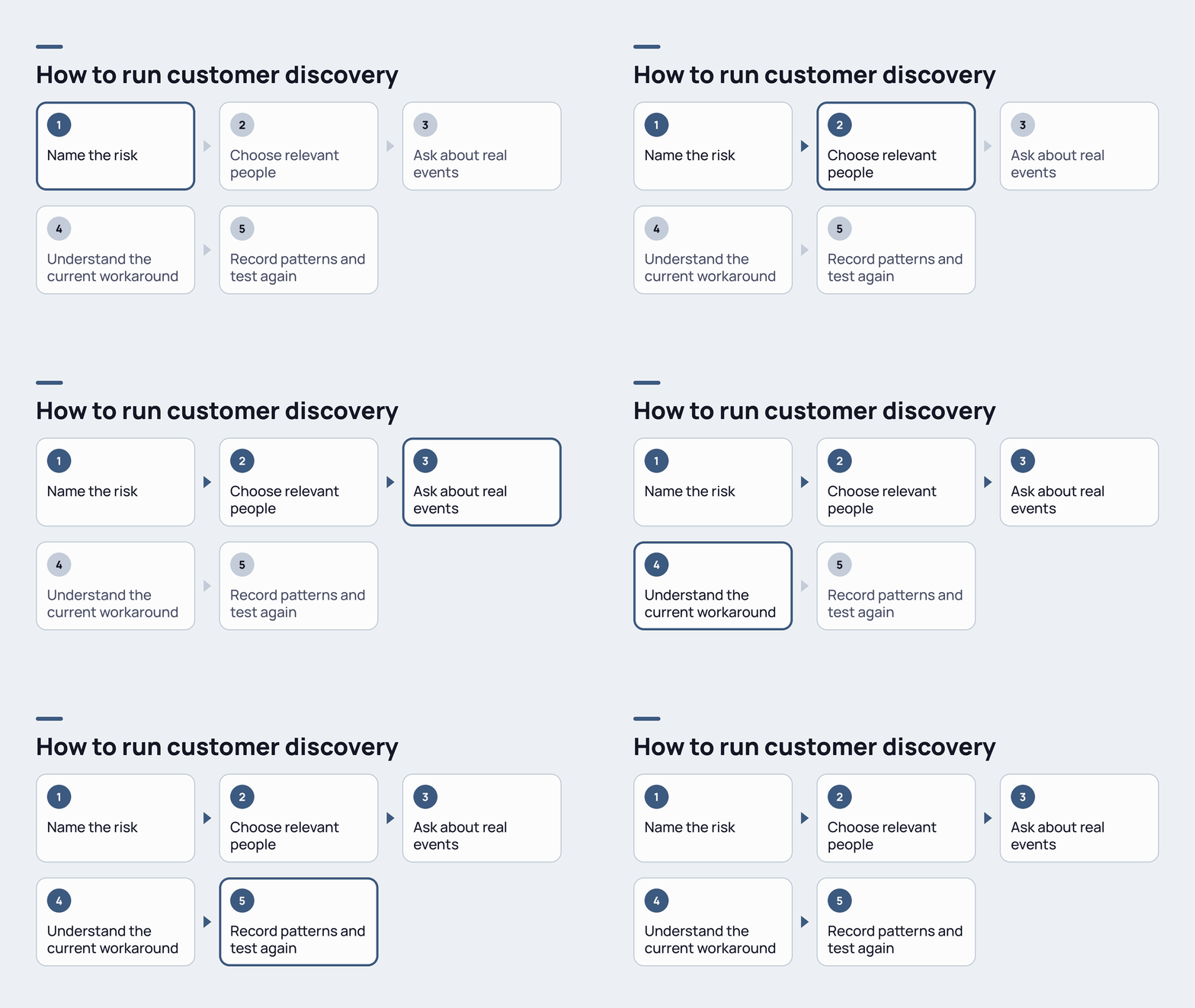
How to run customer discovery
Keep the process focused on one important assumption at a time. A practical sequence is:
- Name the risk. Write down what must be true for your idea to work, such as a specific role regularly encountering a costly task.
- Choose relevant people. Speak with people who have recent experience with that task, not just people who match a broad demographic or are easy to reach.
- Ask about real events. Invite them to describe the last time the problem occurred. Ask what happened next and what was difficult, rather than suggesting answers.
- Understand the current workaround. Look for tools, manual steps, handoffs, delays, and checks. Ask who else is involved and how a solution would be evaluated or approved.
- Record patterns and test again. Separate repeated evidence from one-off opinions. Use what you learn to refine your assumptions, then explore the riskiest open questions in another conversation or a focused prototype test.
For AI products, do not treat a convincing demo as the end of discovery. Test the workflow around the model too: what information it receives, how users judge its output, and what happens when it is wrong or incomplete. Avoid asking people to share sensitive data just to make a test feel realistic.
Five areas to explore—and terms to separate
There is no single official list of “five types” of customer discovery. A useful way to organize what you learn is to investigate five areas:
- Customer: who experiences the problem?
- Problem: what task or need causes difficulty?
- Workaround: how do people handle it now?
- Decision: who chooses, pays for, or approves a solution?
- Constraints: what could prevent adoption, including trust, data, or workflow needs?
Customer discovery is also different from customer service, which focuses on helping customers resolve issues, and from customer experience frameworks. The “5 Cs” of customer experience can vary by source; they are not a universal customer discovery method. Customer development is a broader startup process, while product discovery focuses on deciding what product to build. These activities can inform one another, but they answer different questions.
Turn discovery into a product decision
After each round of research, summarize what you heard, what evidence supports it, and what remains uncertain. Then choose a concrete next step: investigate a different customer group, revise the problem statement, or test a limited version of the workflow. Discovery is useful when it changes what you do next, not when interviews simply accumulate.
If you need support turning product decisions into a working release, The Morning Company offers product consulting and turnkey MVPs for AI startups.
Turn customer insight into an AI startup MVP.
The Morning Company provides product consulting and turnkey MVPs, from your first product decision to a working release.
Explore product supportWhat's next
Next, learn how to turn interview findings into a clear problem statement and a focused MVP scope.